
How Secure ECU File Payment Should Work
March 17, 2026
11 min read
72 views
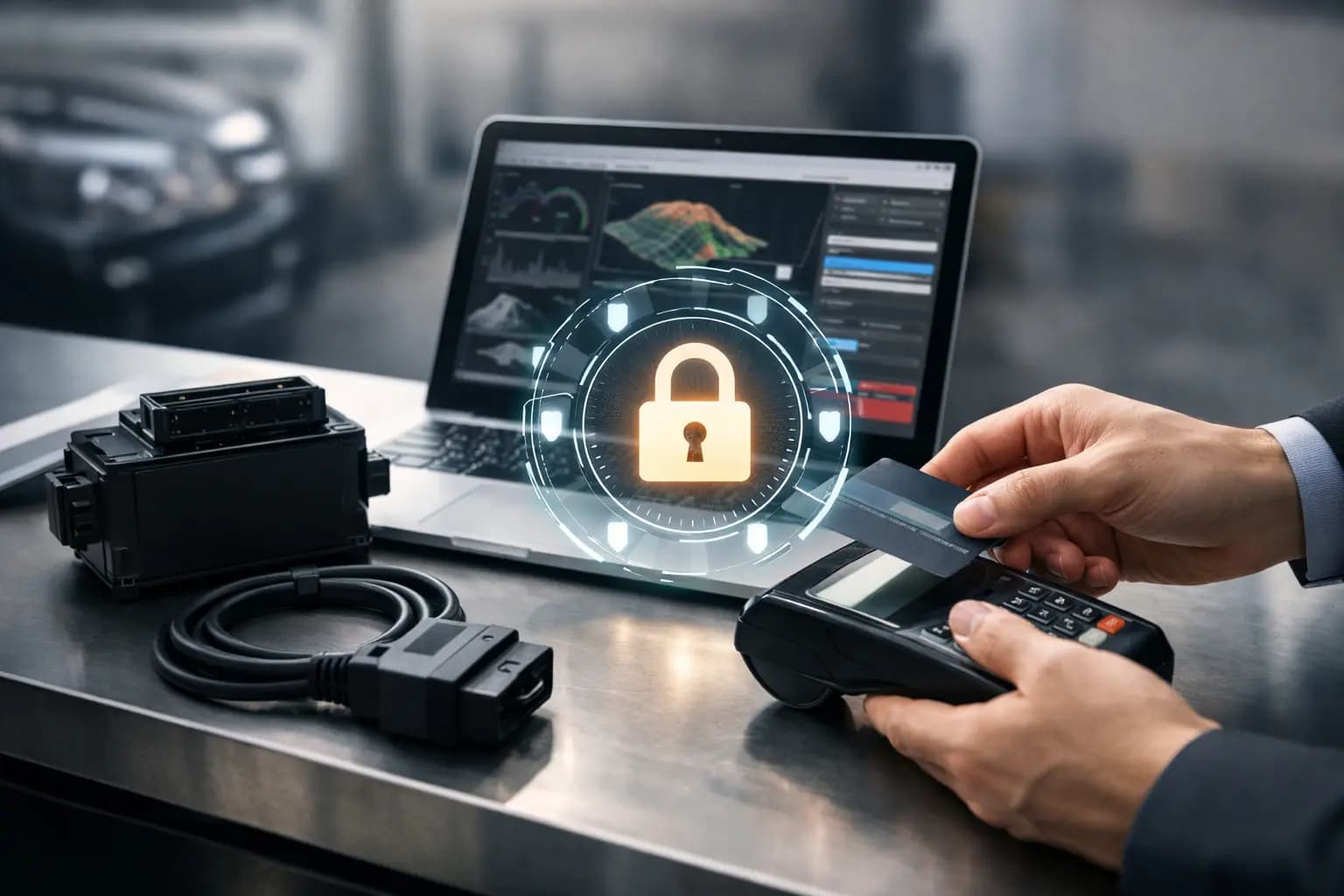
Secure ECU file payment ensures fast workflow, protects vehicle data, and reduces operational risks in professional tuning businesses.
A customer is waiting, the vehicle is on the lift, and your read file is already pulled. At that point, payment is not an admin task. It is part of your production workflow. If the payment process is slow, unclear, or risky, the entire tuning job stalls.
That is why secure ecu file payment matters more than many shops first realize. You are not only buying credits or paying for a modified file. You are protecting vehicle data, preserving turnaround time, controlling costs, and reducing the chance of disputes that interrupt your schedule. For professional tuners, remap agents, and performance shops, payment security is operational security.
Why secure ecu file payment matters in a tuning workflow
In a professional ECU or TCU calibration process, every step depends on the one before it. You read the original file, upload it, receive a tested modification, write it back, and confirm the result. Payment sits right in the middle of that chain.
If the payment side is weak, several problems appear fast. The first is delay. Manual invoicing, back-and-forth confirmations, or unclear credit balances add friction when you need a file turned around in minutes, not hours. The second is trust. Shops need confidence that the platform handling payments is also handling customer orders, file history, and delivery in a controlled way. The third is accountability. When there is a clear portal-based system, you can track what was purchased, when it was ordered, and which file was delivered.
For tuning businesses, that structure protects margins as much as it protects data. You can quote jobs accurately, keep file purchases organized across technicians, and avoid the confusion that comes with scattered chats, informal transfers, or undocumented orders.
What a professional secure ecu file payment system includes
A professional payment setup should feel like part of the tuning platform, not a separate patch. The best systems connect account access, credit purchasing, file uploads, order tracking, and delivery inside one controlled environment.
That matters because tuning files are not generic digital products. They are tied to a specific original read, a specific control unit, and a specific service request. Payment therefore needs to support traceability. If a shop buys credits, uploads a file, and receives a calibration, the portal should record that chain clearly.
A reliable secure ecu file payment system usually includes protected account login, controlled credit purchases, visible order status, and documented file delivery. It should also support role clarity inside a shop. If multiple technicians or staff members access the same account, there needs to be a clean way to manage transactions and prevent internal mistakes.
Speed is part of security too. That may sound counterintuitive, but in practice it is true. A fast, standardized credit-based process reduces the temptation to use side-channel payments, rushed screenshots, or manual workarounds. The more disciplined the workflow, the lower the risk of payment confusion.
Credits vs one-off payments: what works best for shops
For a tuning professional, credit-based purchasing usually makes more sense than one-off payment handling on every file. It simplifies quoting, shortens job intake, and gives the business a predictable way to manage file costs.
There is also a security advantage. When your team works from a funded credit balance inside a portal, the payment event happens before the pressure of the live job. That means less chance of entering payment details in a rush, less dependence on manual approval, and less friction when a customer is already waiting.
That said, it depends on volume. A high-throughput shop benefits heavily from credits because it keeps operations moving. A low-volume operator may prefer more flexible purchasing if cash flow is tighter. Even then, the core issue stays the same: the process should be transparent, documented, and attached to the actual calibration order.
Payment security is also file security
In this industry, payment security cannot be separated from file handling security. The original read file often represents customer vehicle data, shop labor, and the starting point for a professional calibration job. If the platform is careless with payment access, it raises questions about how it handles file storage, order routing, and tuned file delivery.
A serious platform should treat both payment and file exchange as part of one engineering-led process. That includes secure account access, a stable customer portal, consistent order references, and controlled delivery of the modified file. The benefit is practical, not theoretical. When something needs to be checked later, you can trace the order instead of searching through email threads or messaging apps.
This is one reason professional tuners tend to prefer structured portals over informal file sellers. The issue is not just convenience. It is repeatability. If your shop reputation depends on consistent outcomes, the system behind the file purchase has to be consistent too.
What to look for before you trust a file provider with payment
A provider does not earn trust because it can process a transaction. It earns trust because payment, calibration, support, and delivery work together without weak points.
First, look at workflow maturity. If the provider has a clear account system, defined credit packages, straightforward upload steps, and visible order handling, that is a strong sign of professional operations. Second, evaluate support access. If a payment issue or order question appears during a live job, waiting until the next business day can cost you the customer. Around-the-clock technical assistance is not a marketing extra for this market. It is operational protection.
Third, assess calibration credibility. A secure payment portal is useful, but it only solves part of the problem. The file itself still needs to be tested, optimized, and delivered with confidence. Shops should look for professional calibration standards, warranty-backed service language, and evidence of real software engineering capability, including WinOLS experience and broad tool compatibility.
Finally, watch for clarity. Hidden charges, vague delivery expectations, or inconsistent file pricing create the same business risk as poor payment handling. Good systems remove uncertainty.
How secure payment improves customer delivery at your shop
Customers rarely ask how you paid for a tuning file. They notice the result instead. They see whether the vehicle was finished on time, whether the process looked professional, and whether there were avoidable delays.
That is why secure ecu file payment has a direct effect on your end customer experience. When your purchasing process is controlled, your workflow becomes more predictable. You can schedule jobs more accurately, reduce downtime between read and write, and spend less time chasing confirmations.
The business benefit is even bigger for shops handling multiple vehicles per day. A standardized portal with prepaid credits and tracked orders lets technicians stay focused on the vehicle, not on payment admin. It also helps management control costs across staff and avoid duplicate purchases or undocumented orders.
For mobile tuners and resellers, this matters even more. They operate under tighter time windows and often with less room for back-office support. A stable platform turns payment into a routine step instead of a risk point.
The best systems reduce disputes before they start
Most payment disputes in this space are not caused by fraud. They come from unclear expectations, poor documentation, or disconnected communication. A file was ordered under pressure, the request details were incomplete, the payment method was informal, or the delivery trail was messy.
A professional portal reduces those problems early. Credits are visible. Orders are logged. The uploaded original file is attached to the request. The returned calibration is tied to the same job record. If there is a question, both sides have a clear reference point.
That structure is especially valuable when multiple services are offered, such as Stage 1, Stage 2, DPF, EGR, AdBlue, or TCU work. Pricing and order scope need to stay precise. Secure payment, in that context, is not only about protecting funds. It is about defining exactly what was requested and delivered.
Choosing a provider that matches professional standards
If you are evaluating a tuning file source, treat payment security as part of service quality. A professional provider should offer a controlled portal, clear credit purchasing, fast order handling, and direct support when timing matters. It should also back that process with tested calibrations, strong software expertise, and a workflow that fits the tools you already use.
That is the model behind ECU-Chiptuningfiles.com: a credit-based file service built for professional tuners who need fast turnaround, structured ordering, and dependable calibration support in one place. For shops that value repeatability, that kind of setup is usually a better fit than piecing together payments and file delivery across separate channels.
When payment is secure, documented, and integrated into the calibration process, you spend less time managing risk and more time delivering results your customers can feel on the road. That is where a professional tuning operation should stay focused.
Tags
ecu tuningecu file paymentsecure ecu paymentchiptuning workflow
Last updated: September 29, 2026
Related Posts
ECU Chiptuning
What Is a Safe Turbo Boost Target?
Discover how to set a safe turbo boost target by balancing airflow, fuel, temperature, and ECU strategy for reliable and repeatable performance.
22 min
117
ECU Chiptuning
ECU Fault Code Fixes That Actually Last
An ECU software fault code fix is not just about clearing a warning light. Professional tuning shops combine diagnostics, calibration logic, and hardware checks to prevent recurring faults and ensure reliable vehicle performance.
20 min
138
ECU Chiptuning
What Is a Custom ECU Calibration File?
A custom ECU calibration file is a modified engine control unit software built from the original vehicle file. It optimizes torque, fuel management, boost control, and safety limits for a specific vehicle configuration.
21 min
191