
ECU Fault Code Fixes That Actually Last
March 15, 2026
20 min read
109 views
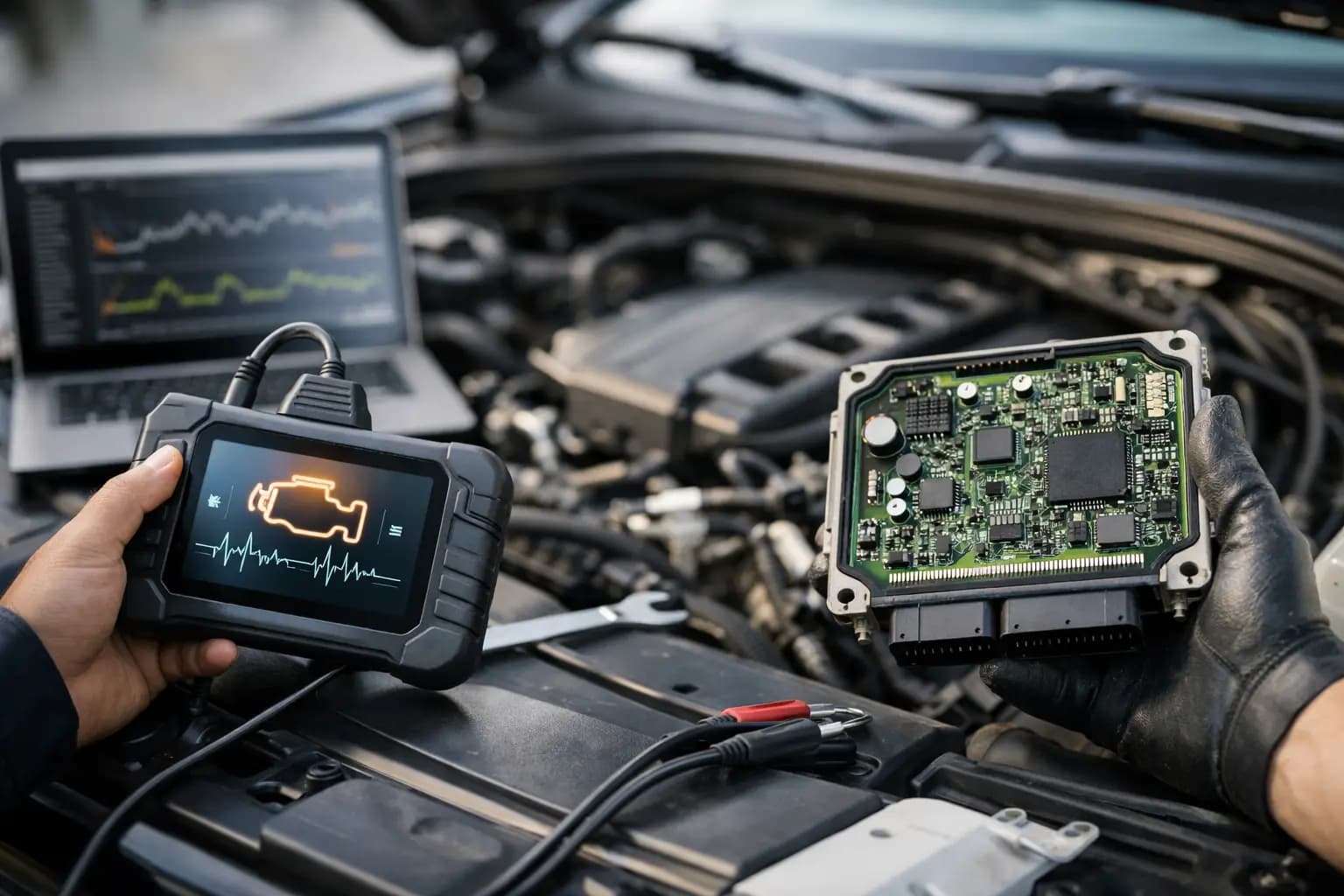
An ECU software fault code fix is not just about clearing a warning light. Professional tuning shops combine diagnostics, calibration logic, and hardware checks to prevent recurring faults and ensure reliable vehicle performance.
ECU Software Fault Code Fix: What It Really Means
A fault code that repeatedly appears after being cleared is rarely a simple scanner issue. In most cases, the ECU is indicating that a diagnostic threshold, plausibility check, or subsystem model no longer matches the vehicle’s real operating conditions.
For a tuning shop, this matters because customers do not judge the work by the software flash alone. They judge it by whether the vehicle leaves the workshop without warning lights, limp mode, or the need for repeat visits.
That is why an ECU software fault code fix should be approached as calibration work rather than simply hiding a code. On modern ECUs, diagnostic trouble codes are connected to enable conditions, monitoring logic, torque models, sensor rationality, and aftertreatment strategies.
Changes to airflow, boost pressure, EGR behavior, catalyst logic, DPF operation, transmission torque requests, or component configuration can all trigger faults even when the vehicle still drives normally.
A proper solution restores consistency between the software calibration and the vehicle’s real operating state. Sometimes this requires adjusting diagnostic thresholds or switches. In other cases, related calibration maps must be corrected so monitoring systems remain valid. And occasionally, the correct solution is not software at all.
When a Software Fault Code Fix Is the Right Solution
Experienced tuners understand the difference between a valid calibration adjustment and a shortcut that creates larger problems later.
If a vehicle has undergone supported modifications, component adaptations, or known calibration mismatches, software adjustments may be the correct solution.
One common example involves aftertreatment systems. When components are modified or replaced, factory diagnostic routines may no longer align with the vehicle configuration.
Another example is platform-specific plausibility faults that appear after performance calibration changes. These often occur when torque modeling, boost requests, or air mass calculations are no longer balanced.
In such cases, leaving diagnostics unchanged can lead to nuisance DTCs, reduced performance, and customer complaints.
There are also situations where OEM software versions contain known sensitivity issues. If the fault originates from calibration rather than a failing sensor, actuator, or wiring issue, an ECU software fault code fix can stabilize the vehicle and protect drivability.
However, experienced workshops avoid using software to mask genuine hardware failures.
If an EGT sensor fails, a NOx sensor drifts, the boost system leaks, or a transmission has a mechanical issue, disabling the code only removes the warning light while the real problem continues to worsen.
That is not a fix. It simply delays the inevitable comeback.
Why Fault Code Fixes Often Fail
Most unsuccessful DTC solutions occur because one code is treated in isolation.
The ECU does not work that way.
A single fault may exist within a broader control system. For example, an underboost code may involve turbo control, boost targets, air mass plausibility, smoke limitation strategies, torque monitoring, and protective functions.
If only the visible DTC is disabled while the underlying logic still detects an impossible condition, the result may be a different fault code or a vehicle entering limp mode.
The same principle applies to emissions systems and gearbox strategies. Disabling the visible monitor while leaving torque intervention or thermal protection logic untouched can cause poor shift behavior, inconsistent regeneration cycles, or incomplete diagnostic readiness.
This is why file quality matters. Professional calibration work evaluates the entire system surrounding the fault code rather than simply modifying the code table itself.
That requires platform knowledge, tested damos or map identification, and experience with how specific ECU families manage diagnostics across software versions.
The Diagnostic Process Before an ECU Software Fault Code Fix
Reducing comebacks starts with the process before any file modification takes place.
Begin with a full vehicle scan rather than focusing only on the customer-reported code. Freeze frame data, status bits, historical faults, and related modules often reveal whether the problem is primary or secondary.
Modules such as the TCU, ABS, gateway, and body control system can provide valuable context for why an ECU fault is triggered.
Next, confirm the vehicle configuration. Determine whether components have been removed, replaced, retrofitted, or previously tuned.
Many recurring DTC issues result from stacked calibrations or modified files with undocumented changes.
After that, verify the hardware baseline. Check sensor plausibility, wiring integrity, vacuum or boost leaks, actuator movement, and battery voltage stability.
If the vehicle has a physical defect, software changes should wait until the hardware issue is resolved.
Finally, confirm the ECU software version and the reading method used. OBD, bench, and boot reads can all be valid, but the file must be complete and matched to the exact hardware and software identification.
This prevents applying a generic fix to a platform-specific issue.
What a Professional Calibration-Based Fix Should Include
A proper solution is not simply “DTC off.” It must be engineered around the ECU’s operating logic.
This includes determining whether a diagnostic monitor should be disabled, rescaled, or supported with related calibration adjustments.
On many platforms, torque models, airflow calculations, readiness states, and component diagnostic parameters must remain consistent.
If these elements are not aligned, the vehicle may appear fixed in the workshop but fail under load, during cold start, or during regeneration events.
Professional calibration work also considers tool compatibility and safe writing procedures.
Shops need files that can be flashed reliably using their existing tools without repeated trial and error.
Consistency and repeatability matter because efficient workshop workflows depend on predictable results.
Signs the Problem Is Not Software
Experienced tuners recognize patterns that indicate hardware issues rather than calibration problems.
Intermittent communication faults, low voltage events, implausible sensor readings at key-on, or faults that immediately reappear after clearing often point toward electrical or mechanical problems.
Actuator current faults, open-circuit or short-to-ground errors, and mechanical regulation faults confirmed through live data are also strong indicators of hardware failure.
If multiple unrelated DTCs appear across different control modules, software should not be the first approach.
Instead, power supply stability, grounding integrity, CAN network communication, possible water damage, and previous repair quality should be investigated.
There is also a business reason to follow this discipline. When software is used to hide a hardware issue, the vehicle usually returns with a larger problem later.
Why Tuning Businesses Outsource This Work
Even experienced performance workshops often outsource diagnostic calibration work.
Different ECU families manage DTC logic, torque intervention, aftertreatment monitoring, and checksum structures in very different ways.
Verifying every strategy across software versions can quickly exceed the margin of a single job.
By outsourcing to professional calibration providers, workshops gain access to tested solutions, broader vehicle coverage, and engineering-level file preparation without slowing down their workflow.
For businesses operating at scale, consistency is more valuable than raw speed.
Reliable ordering systems, credit-based file services, and fast turnaround times help standardize jobs across technicians and locations.
This is why many remap agents and workshops rely on professional file services instead of building every calibration internally.
At ECU-Chiptuningfiles.com, this workflow is designed for professional users who need dependable ECU and TCU file support, fast delivery, tested calibrations, and 24/7 technical assistance.
How to Avoid Fault-Code Comebacks After Flashing
The final quality check should be just as thorough as the calibration request itself.
After flashing the file, run a complete vehicle scan again and clear any residual faults. Verify which monitors return and which remain inactive as expected.
Then road-test the vehicle under the same conditions that originally triggered the fault.
Idle-only checks are not sufficient for load-based or temperature-dependent diagnostics.
If the vehicle involves transmission interaction, verify torque behavior and shift quality. If aftertreatment systems were involved, review live data and readiness status.
Most importantly, maintain a high professional standard.
The best ECU software fault code fix is the one that leaves the vehicle operating consistently, the customer confident, and the workshop free from unnecessary rework.
The real success is not simply turning off a warning light.
It is delivering a calibration that behaves as if it truly belongs in the vehicle.
Tags
ecu fault code fixecu software errordtc solutionvehicle diagnostics
Last updated: September 12, 2026
Related Posts
ECU Chiptuning
What Is a Safe Turbo Boost Target?
Discover how to set a safe turbo boost target by balancing airflow, fuel, temperature, and ECU strategy for reliable and repeatable performance.
22 min
106
ECU Chiptuning
What Is a Custom ECU Calibration File?
A custom ECU calibration file is a modified engine control unit software built from the original vehicle file. It optimizes torque, fuel management, boost control, and safety limits for a specific vehicle configuration.
21 min
165

ECU Chiptuning
How Secure ECU File Payment Should Work
Secure ECU file payment ensures fast workflow, protects vehicle data, and reduces operational risks in professional tuning businesses.
11 min
50