
What Is a Safe Turbo Boost Target?
March 28, 2026
22 min read
117 views
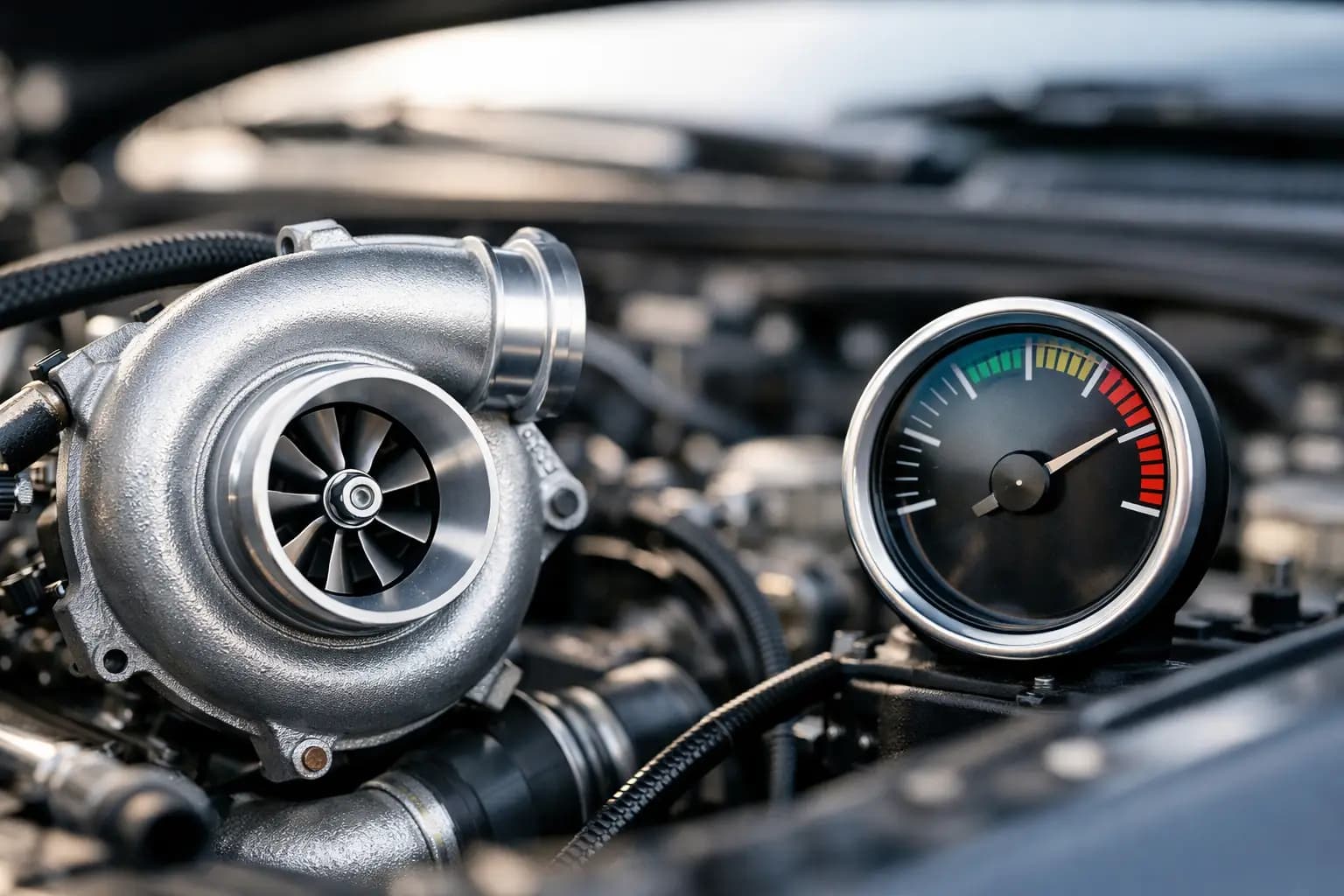
Discover how to set a safe turbo boost target by balancing airflow, fuel, temperature, and ECU strategy for reliable and repeatable performance.
A customer asks for more boost, the dyno graph looks clean, and the hardware list seems solid. That still does not answer the real question: what is a safe turbo boost target for that engine, that turbo, that fuel, and that use case? In professional calibration work, boost is never a standalone number. It is a result of the full strategy inside the ECU, and it only becomes safe when airflow, charge temperature, ignition, lambda, fuel system capacity, torque modeling, and protection routines all agree with it.
For tuning shops and file service resellers, this is where jobs are won or lost. A boost target that looks conservative on paper can still create knock, overspeed the turbo, or push exhaust gas temperature too high. On the other hand, a target that sounds aggressive can be perfectly repeatable if the calibration is built around the real limits of the platform. The goal is not to chase peak pressure. The goal is to deliver stable performance with margin.
Why a safe turbo boost target is not one fixed number
There is no universal psi figure that applies across modern gasoline and diesel platforms. A small factory turbo on pump gas may reach its practical limit at a lower pressure ratio than a larger aftermarket unit running better intercooling and higher-octane fuel. Even within the same engine family, two cars with different ambient conditions, maintenance history, and hardware condition can tolerate very different results.
This is why experienced calibrators work backward from airflow and efficiency, not forward from a customer request. The turbocharger compressor map matters. So do turbine speed, backpressure, intake air temperature, injector headroom, high-pressure fuel pump behavior, and combustion stability. If one part of the system falls behind, the boost target stops being safe even if the engine does not fail immediately.
A professional file should also account for the vehicle's real operating pattern. A street car that sees short pulls has different thermal exposure than a tow vehicle, track car, or heavy diesel working under sustained load. The longer the engine stays under boost, the tighter the acceptable margin becomes.
How to define a safe turbo boost target in calibration work
The right starting point is not maximum boost. It is the maximum repeatable load the engine can support without losing control of temperature, fuel delivery, or knock activity. Boost is only one lever used to reach that load target.
On torque-based ECUs, the process gets even more nuanced. The requested torque, driver demand, torque intervention strategy, load ceilings, boost control logic, and modeled component protection all need to align. If they do not, you can end up with oscillation, throttle closure, torque monitoring errors, or inconsistent delivery between gears. That is why a clean boost curve often depends more on proper torque structure than on wastegate duty changes alone.
For gasoline applications, a safe target usually means the engine can hold commanded lambda under peak load, maintain ignition timing within a stable window, and avoid repeated correction from knock control. For diesel, the picture shifts slightly toward exhaust temperature, smoke control, rail pressure stability, turbo speed, and cylinder pressure management. In both cases, safety means the calibration remains controlled when conditions are less than ideal, not only when the car is cool and the fuel is fresh.
Fuel quality changes everything
Pump gas is one of the biggest variables in boost safety. A file that behaves properly on high-quality 93 octane can become far less tolerant on inconsistent 91 octane or poor seasonal fuel. Ethanol blends can add knock resistance and cooling effect, but only if the fueling system and content strategy support them properly.
This is where many unsafe tunes reveal themselves. The peak boost number may not look extreme, yet the ignition angle becomes unstable, fuel trims drift, or the high-pressure system falls behind. A genuinely safe calibration leaves room for fuel variation instead of assuming best-case conditions every time.
Turbo efficiency matters more than pressure alone
Two setups can both run 24 psi and produce very different outcomes. One turbo may be operating in an efficient zone with moderate outlet temperatures. The other may be near the edge of the map, creating excessive heat and forcing the ECU to pull timing or enrich heavily to compensate.
That is why an engineer-led tuning process looks at boost in context with mass airflow and compressor efficiency. If raising boost produces little real airflow gain and a large temperature penalty, the target is no longer efficient and usually no longer safe. More pressure does not automatically mean more usable power.
The hard limits behind a safe turbo boost target
When calibrators set limits, they are managing hardware survival and control system stability at the same time. The most common ceiling is not the strongest component. It is the weakest one.
The fuel system is often that weak point. Once injector duty cycle, rail pressure, or pump delivery starts approaching its limit, the boost target must be capped or reshaped. Knock control is another major checkpoint on direct-injection gasoline engines. If the ECU is constantly removing timing in key load areas, the file is already beyond its comfortable operating window.
Thermal control is just as important. Charge air temperature, exhaust gas temperature, and coolant temperature all influence what a safe target looks like. A setup that survives one pull on the dyno may still be too aggressive for repeated acceleration, highway load, towing, or hot-weather use. Professional tuning has to reflect how the vehicle is actually driven.
Then there is turbocharger speed. Many failures blamed on "too much boost" are really overspeed events caused by trying to hold pressure too high in the upper rpm range, especially on small factory units. The pressure number alone can hide how hard the shaft is working. Good calibration strategy often tapers boost where the turbo becomes inefficient, because that is how you protect power and reliability at the same time.
Common mistakes shops make when setting boost targets
The first mistake is copying a headline number from another build. Matching someone else's peak psi without matching their hardware, fuel, climate, and calibration logic is not a strategy. It is guesswork.
The second is treating boost as the main performance metric. Customers ask for it because it is easy to understand, but airflow, torque, and repeatability matter more. A lower peak boost curve with better timing stability and lower intake temperatures often delivers a stronger real-world result.
The third is ignoring ECU protections or trying to suppress them instead of calibrating around them. If torque monitoring, modeled protection, or intervention strategies are fighting the tune, the answer is not to disable everything. The answer is to build a file that works with the platform correctly.
Another common issue is failing to define the use case. A daily-driven truck, a stage 1 commuter car, and a weekend track build should not share the same safety margin. Safe always depends on purpose.
Building safer results through process
For professional tuners, the safest route is a structured calibration workflow. Start with a verified stock read, identify the exact ECU or TCU strategy, confirm hardware condition, and review the supporting modifications honestly. Then set load and torque goals that the system can sustain before deciding how much boost is required to reach them.
Logging is essential. You want to see boost actual versus target, ignition behavior, lambda, fuel pressure, air temperature, throttle angle, wastegate or VNT control, torque intervention, and any signs of modeled limit engagement. One clean pull is not enough. Repeated consistency is the real standard.
This is also where a dependable file supplier adds value. A tested calibration built around known platform behavior reduces the risk of drivability complaints, warning lights, and avoidable mechanical stress. For shops managing multiple brands and ECUs, working with a service built for fast turnaround and calibration support can protect both customer vehicles and shop reputation. At ECU-Chiptuningfiles.com, that engineering-first workflow is exactly the point.
A practical way to think about safe boost targets
Instead of asking, "How much boost can this engine take?" ask a better question: "At what boost level does this package still maintain fuel control, thermal control, turbo efficiency, and combustion stability with margin?" That is the number that matters.
Sometimes the safe answer is lower than the customer expects. Sometimes it is higher than internet advice suggests. The correct target comes from calibration data, not forum pressure. Shops that stay disciplined here deliver better repeatability, fewer comebacks, and stronger long-term customer trust.
FAQ: safe turbo boost target
Is higher boost always more power?
No. Once the turbo moves outside an efficient range, higher boost can increase heat faster than airflow. At that point, power gains flatten and engine stress rises.
Can the same engine always use the same boost target?
No. Fuel quality, turbo condition, ambient temperature, intercooling, and calibration strategy all change what is safe.
Is a conservative tune always safe?
Not automatically. A file can run modest boost and still be unsafe if fueling, timing, torque control, or temperature management are poorly calibrated.
Should boost taper at high rpm?
Often yes. On many stock-frame turbos, tapering boost in the upper range helps avoid overspeed, lowers heat, and keeps the power curve usable.
The safest boost target is the one the whole system can support every time, not the one that looks best in a sales conversation.
Tags
turbo basıncıecu tuningturbochargerengine safety
Last updated: September 27, 2026
Related Posts
ECU Chiptuning
ECU Fault Code Fixes That Actually Last
An ECU software fault code fix is not just about clearing a warning light. Professional tuning shops combine diagnostics, calibration logic, and hardware checks to prevent recurring faults and ensure reliable vehicle performance.
20 min
137
ECU Chiptuning
What Is a Custom ECU Calibration File?
A custom ECU calibration file is a modified engine control unit software built from the original vehicle file. It optimizes torque, fuel management, boost control, and safety limits for a specific vehicle configuration.
21 min
191

ECU Chiptuning
How Secure ECU File Payment Should Work
Secure ECU file payment ensures fast workflow, protects vehicle data, and reduces operational risks in professional tuning businesses.
11 min
72