
What Is a Custom ECU Calibration File?
March 12, 2026
21 min read
14 views
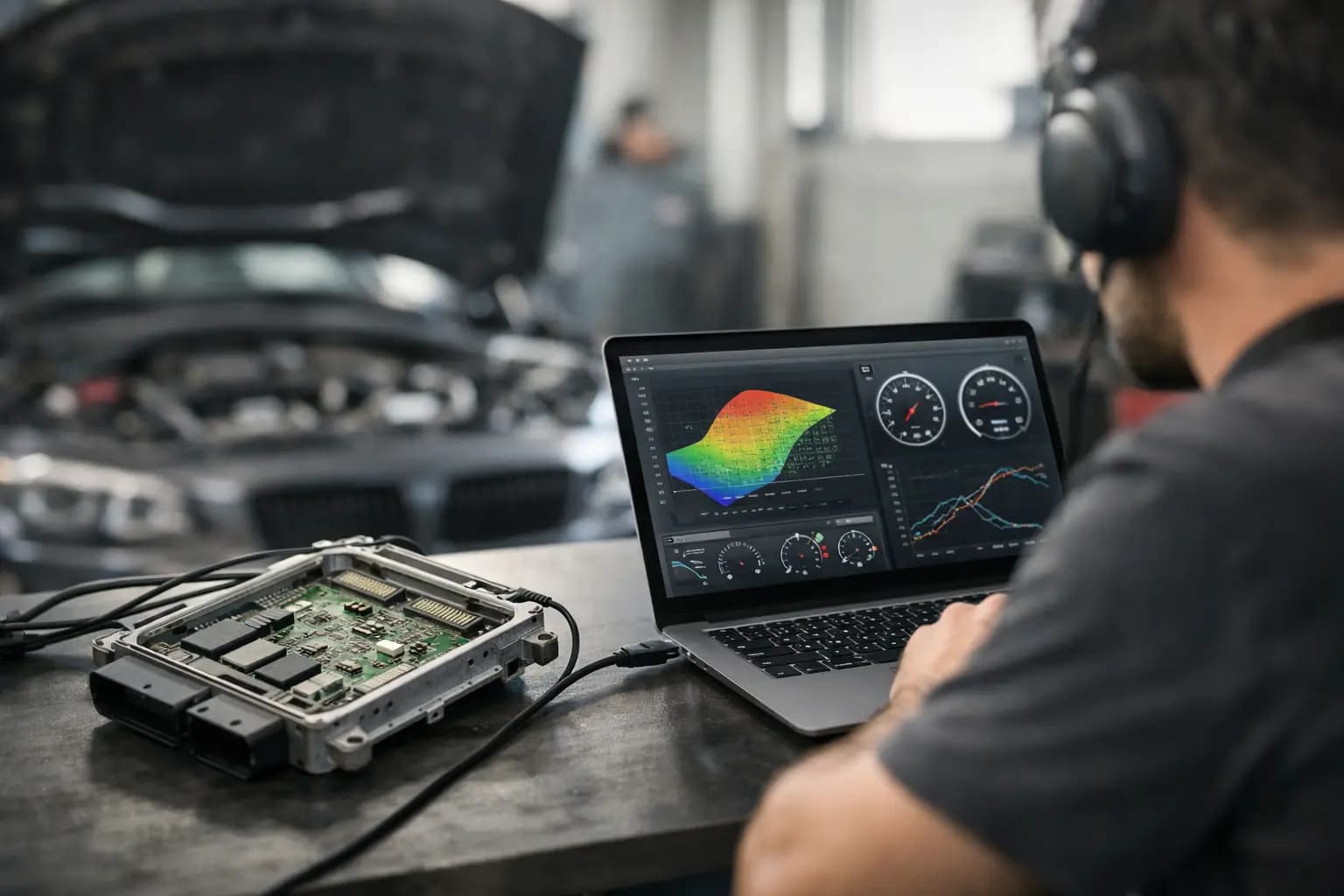
A custom ECU calibration file is a modified engine control unit software built from the original vehicle file. It optimizes torque, fuel management, boost control, and safety limits for a specific vehicle configuration.
A vehicle can work well with stock software. But working well does not mean it has the most accurate calibration for a specific usage scenario. When a larger turbo, different fuel quality, DPF-EGR strategies, torque limits, transmission behavior, or simply a cleaner power curve is desired, the issue is no longer “loading a file,” but creating the right calibration.
That's why tuning professionals often ask: what is a custom ECU calibration file? In other words, what exactly is a custom ECU calibration file, and why is it different from a ready-made “one size fits all” file?
The short answer is: A custom ECU calibration file is modified software that recalibrates the performance, torque, fuel, pressure, limiter, and protection strategies within the ECU to suit the target, based on the original readings of a specific vehicle. The critical point here is that the file is not produced for a general vehicle model, but for that specific vehicle's software version, hardware combination, and usage expectations.
What is a custom ECU calibration file and why is it different from a standard file?
A standard tuning file often provides a general solution tailored to the same ECU family or engine code. While this approach saves time in some cases, not all vehicles are identical. Even two vehicles from the same model year may have different software IDs, hardware revisions, or emission strategies.
This is where custom calibration comes into play. The calibrator reads the original file, analyzes the ECU type and software architecture, then processes the relevant maps and limit tables on that file. In other words, the process is not simply adapting a file found on the internet to the vehicle. The real work is to produce the desired result within safe margins without disrupting the vehicle's existing software logic.
From a professional perspective, the difference is not just about power increase. Throttle response, torque demand, rail pressure management, boost target, lambda strategy, smoke limit, temperature protections, and in some cases transmission compatibility are all evaluated together. A good custom file treats these parameters not as separate entities but as a single system.
What actually changes in a custom ECU calibration file?
A custom calibration file does not rewrite the application software inside the ECU. The section that usually changes is the calibration data. In other words, the tables, axes, limiters, and correction maps that the ECU references when making decisions are readjusted.
Depending on whether it's a gasoline or diesel application, the most frequently modified areas are the torque model, load calculation, ignition or injection strategy, turbo control, fuel quantity, pedal demand, and various protection thresholds. In modern ECUs, these maps work in conjunction with each other, so simply increasing a single value is not sufficient. For example, if you increase boost demand without properly addressing torque limiters or temperature-based protections, the result will either be a file that doesn't produce power or one that compromises driving quality.
Therefore, professional calibration is not just about increasing a few maps; it is a controlled balancing process. Power gain is desired, but drivability, risk of the check engine light, smoke levels, knock margin, exhaust temperature, and component load must also be monitored simultaneously.
Why is the original file so important?
The basis of custom calibration is always the vehicle's original reading. This is because the calibration ID, checksum structure, software version, and map placement within the ECU are determined accordingly. Using a “similar” file for the same vehicle can pose serious risks, especially in modern control units such as MED17, EDC17, MG1, and MD1.
In a professional workflow, the original file is first obtained, the vehicle information is verified, the software structure is examined, and then modifications are applied. This method is not only safer, but also yields more repeatable results. This is the real value for a tuning business. Not a one-time chance, but consistent delivery on every vehicle.
When is custom calibration truly necessary?
A custom file is not required for every vehicle, but it is often the most accurate approach. Custom solutions are particularly meaningful in vehicles that have undergone hardware upgrades, applications using different octane or fuel types, commercial vehicle torque optimization, and platforms with precise emission strategies.
Custom approaches offer advantages even at Stage 1 level. This is because two vehicles that appear identical on paper may not respond the same due to different maintenance histories, sensor tolerances, and software revisions. More importantly, customer expectations vary. One user may want maximum power, another may seek traction and daily usability balance, while another may be fuel economy-focused. When the calibration target changes, the logic of the file must also change.
The same situation is even more critical in commercial use. A vehicle operating under towing load is not calibrated in the same way as a weekend performance vehicle. Safe exhaust temperature, mid-range torque behavior, and transmission protection logic carry different priorities.
How to prepare a professional custom file?
Here, the process determines the quality of the result. A solid calibration flow starts with the data. The vehicle's original ECU reading is taken, the ECU/TCU type, hardware status, modification list (if any), and customer request are clarified. Then the file is analyzed.
During this analysis phase, the calibrator evaluates the maps, axis structures, torque model, and relevant limiters using professional software such as WinOLS. But good work is not just about finding the map. It is necessary to understand how the maps interact with each other. Especially in modern torque-based ECUs, the driver's pedal demand, calculated load, air mass, torque demand, and boost control are all chained together.
Then, changes are applied according to the target, the checksum structure is corrected, and the file is delivered. A good calibration provider does not consider the job done at this point. If necessary, log review, revision support, and technical feedback are also part of the process. This is exactly what is valuable for tuning companies: technical assurance along with fast delivery.
Where do the risks begin?
Custom calibration produces high values when done correctly. When done incorrectly, however, problems are not usually immediately apparent. The vehicle may feel powerful on the first drive, but after a few days, complaints such as overboost, torque intervention, limp mode, increased smoke, transmission adaptation problems, or thermal load issues may arise.
The most common mistake is focusing solely on peak power figures. However, from a professional tuning perspective, what is more important is how and how safely the power is produced. Especially in diesel applications, when rail pressure and injection duration are increased unevenly, gains may appear on paper, but long-term stress increases. In gasoline turbo engines, aggressive settings made without considering ignition, air temperature compensation, and knock margin are risky.
Therefore, a reliable custom file does not have to be aggressive. The right file is often not the one that delivers the highest numbers, but the one that runs cleanest and does not cause recurring problems in the customer's vehicle.
Why is the right file provider critical for a tuning business?
For a performance shop or mobile tuner working in the field, file quality is directly tied to reputation. There should be no issues when the vehicle is delivered to the customer. Therefore, it is not enough for the file provider to be fast. A structure is needed that analyzes the original file, takes vehicle information into account, offers tested solutions, and provides support when needed.
Process standardization is also important here. A credit-based portal, regular order flow, compatibility with all chiptuning tools, short delivery times, and 24/7 technical support are real operational advantages for professional businesses. Especially in busy workshops, preparing a file in an average of 30 minutes means not only speed but also maintaining daily planning.
For this reason, many professional businesses prefer to work with a reliable engineering team rather than handling calibration entirely in-house. The right partner reduces the internal resource load and lowers the risk of faulty files. The value offered by service-oriented platforms such as ECU-Chiptuningfiles.com becomes apparent here: tested and optimized files, a professional calibration guarantee, and technical support tailored to the workflow.
The practical answer to the question “What is a custom ECU calibration file?”
The simplest practical answer to this question is: A custom ECU calibration file is a working file prepared specifically for the vehicle. It is used not only for more power, but also for more accurate torque management, cleaner driving characteristics, more controlled thermal behavior, and lower operational risk.
A ready-made file sometimes does the job. But if the customer is putting the vehicle on the road on your behalf, “doing the job” is not enough. The file must be prepared according to the correct ECU software, optimized within safe limits, and be revisable when necessary. This is precisely where the line between professional tuning and random file loading lies.
A good custom calibration protects the workshop's reputation before the dyno graph. So, for your next job, look at the file not just as a result, but as a process quality.
Tags
ecu tuningcustom ecu calibrationecu remapengine tuningperformance tuning
Last updated: March 13, 2026